Smart Time Clocks for Staffing Agencies: Facial Recognition, GPS, and Accurate Payrol
Introduction
Running a staffing agency means dealing with constant movement. One day, you are managing a handful of contractors, and the next, you are coordinating dozens across multiple job sites. Keeping track of attendance, hours worked, and client billing in this kind of setup can quickly become overwhelming.
Many agencies still rely on paper timesheets or basic punch systems, but these tools were never designed for a fast-changing workforce. When visibility is limited, small errors start to pile up. Over time, those errors turn into lost revenue, payroll disputes, and frustrated clients.
To stay competitive, staffing agencies need smarter systems that can keep up with their pace. Modern time tracking tools bring everything together, from attendance to payroll, helping agencies stay organized while protecting their bottom line.
Key Takeaways
- Smart time clocks combine biometric verification and GPS tracking to eliminate time theft.
- Automated payroll systems simplify managing multiple pay rates and schedules.
- Real-time job tracking improves billing accuracy and reduces disputes.
- Scalable pricing models help agencies control costs despite high employee turnover.
What Makes a Time Clock “Smart” for the Staffing Industry?
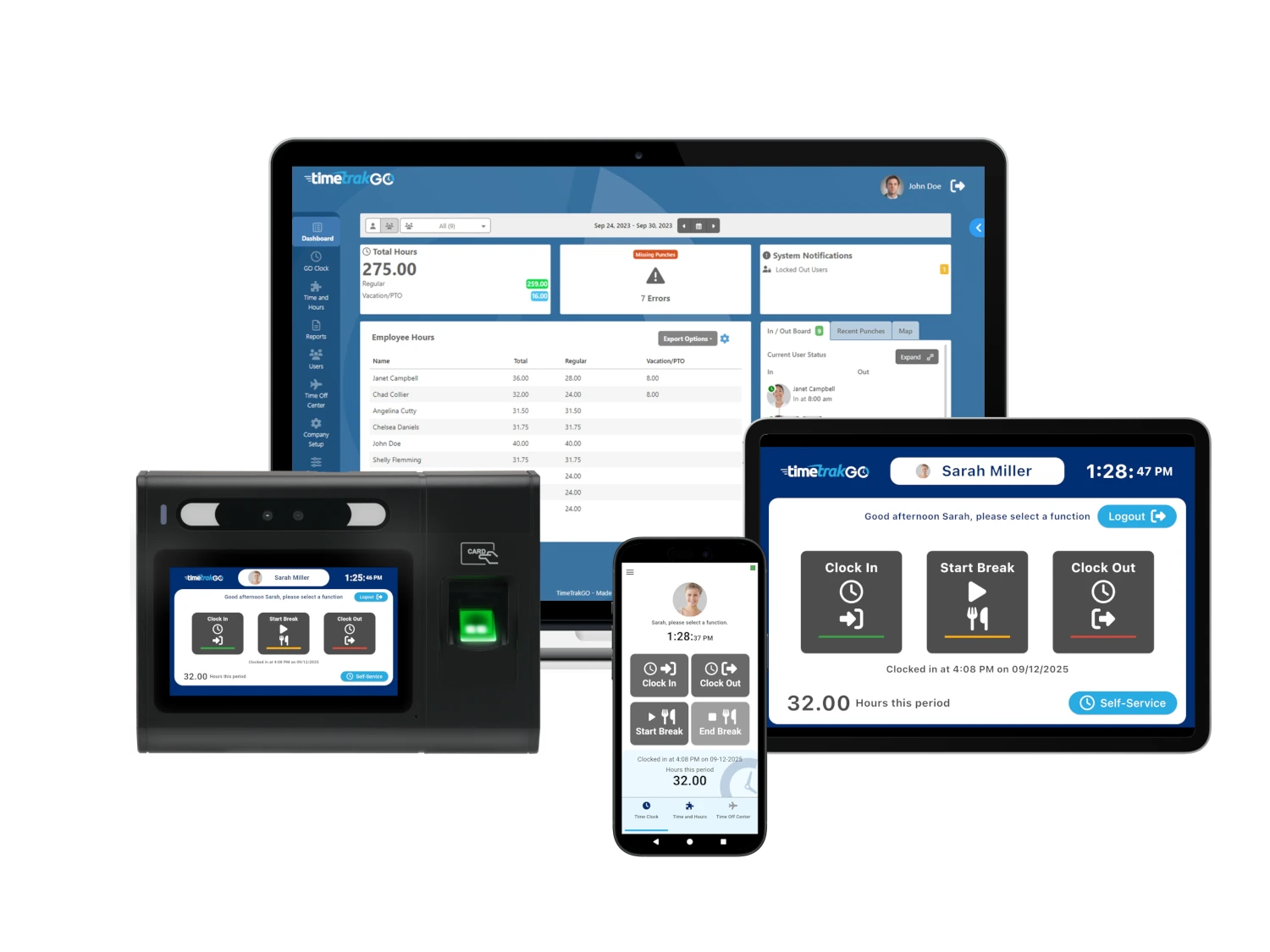
A smart time clock does more than record when someone clocks in or out. It connects attendance data directly to payroll, scheduling, and billing systems, creating a smooth and reliable workflow.
Traditional systems assume employees work in one place with a fixed schedule. That does not match the reality of staffing agencies, where workers move between sites and roles regularly.
A smarter system adapts to that complexity. It tracks time, location, and job assignments all in one place, reducing the need for manual updates and corrections.
| Feature Category | Traditional Time Clocks | Smart Time Tracking Platforms |
| Worker Verification | PIN codes or swipe cards | Biometric facial recognition |
| Location Tracking | None | GPS tracking and geo-fencing |
| Job Costing | Manual entry | Real-time tracking |
| Payroll Integration | Manual processing | Automated calculations |
Eliminating Buddy Punching with Biometric Facial Recognition
Buddy punching is a common issue in staffing environments. One worker clocks in for another, and without proper verification, the system records it as legitimate time worked.
According to the U.S. Department of Labor, accurate tracking of hours worked is part of complying with wage regulations under the Fair Labor Standards Act. When attendance is not properly verified, businesses risk both financial loss and compliance issues.
Biometric facial recognition solves this problem by linking each clock-in to a verified individual. Instead of relying on badges or PINs, the system confirms identity in real time. This ensures that only the person assigned to the shift can log hours.
Verifying Remote Locations via GPS and Geo-Mapping
Staffing agencies often send workers to different client sites, which makes supervision difficult. Without proper tracking, employees might clock in before arriving or from the wrong location.
GPS tracking and geo-fencing help solve this. Agencies can set specific boundaries around job sites, and the system only allows clock-ins within those areas.
This approach gives managers confidence that workers are where they should be. It also ensures clients are billed accurately for actual time worked on-site.
Simplifying Multi-Site Shifts with One-Touch Job Transfers
Temporary workers often switch roles or locations within the same day. Manually tracking these changes leads to delays and errors.
Smart systems allow workers to switch tasks with a single tap. The system logs each transition instantly, making it easier to track hours for different clients or roles.
This feature improves job costing accuracy and removes the need for constant follow-ups with supervisors.
Fixing the Administrative Nightmare: Complex Payroll and Billing
Payroll in staffing agencies is rarely straightforward. Different clients, roles, and shifts often come with different pay rates. Managing all of this manually increases the risk of mistakes.
Switching to automated systems reduces that risk significantly. Instead of relying on spreadsheets, agencies can use software that calculates everything in real time.
This is where tools like an employee time clock for staffing firms become essential. These systems are built specifically to handle complex workforce structures, making payroll and billing much more manageable.
Automating Custom Rules and Multiple Pay Rates
Modern platforms can apply different pay rates based on job roles or locations automatically. If a worker logs overtime or switches tasks, the system adjusts calculations without manual input.
This reduces payroll errors and ensures employees are paid correctly. It also saves time for HR teams who would otherwise need to double-check every entry.
Building Client Trust with Verified Time Records
Accurate billing is critical for maintaining strong client relationships. If there are discrepancies in reported hours, it can quickly lead to disputes.
Smart systems provide detailed records that include identity verification, timestamps, and location data. These records act as proof of work completed.
When clients can see clear and reliable data, trust improves. It becomes easier to justify invoices and maintain long-term partnerships.
Cost-Effective Software Management for High Turnover
High turnover is part of the staffing industry. New workers come in, others leave, and demand can change quickly depending on the season.
Paying fixed software fees for inactive users does not make sense in this environment. Scalable platforms solve this by charging only for active users.
This approach helps agencies control costs while still keeping employee records available. When demand increases, workers can be reactivated without starting from scratch.
Conclusion
Managing a flexible workforce comes with unique challenges, especially when it comes to tracking time and processing payroll. Traditional systems often fall short, leading to errors, lost revenue, and unnecessary stress.
Smart time tracking solutions provide a better way forward. By combining biometric verification, GPS tracking, and automated payroll tools, agencies gain full visibility over their operations.
This shift is not just about improving efficiency. It is about creating a more reliable and scalable system that supports growth. With the right tools in place, staffing agencies can focus less on administrative issues and more on delivering value to their clients.